

 I promised you more posts about my upcoming Gears roleplaying game system and this time I want to share some thoughts on the core mechanic.
When I started the project I was still unsure what dice I wanted to use. I am usually a fan of percentile dice, because they are so easy. You usually roll two ten-sided dice that generate a number between 01 and 100. You then compare this to your chance of success. That’s pretty easy to explain, even to people who never played any game before.
But since I didn’t need that level of granularity (especially with the skills system I had in mind), I decided to use six-sided dice. One d6 would have been a possibility, but in the end I decided to go with 3d6. When using 3d6 you usually get a lot of average results and only a few very low or very high ones. This doesn’t work as well in games that aim for a heroic or cinematic style like D&D, but it fits perfectly the more “down to earth” approach in games like GURPS or what I planned for Gears.
Ok, let’s have a look at the relevant section in the Gears rulebook:
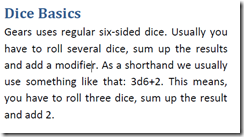
Dice Basics
Gears uses regular six-sided dice. Usually you have to roll several dice, sum up the results and add a modifier. As a shorthand we usually use something like that: 3d6+2. This means, you have to roll three dice, sum up the result and add 2.Basic Task Resolution
The basic task resolution method is to roll 3d6 and compare it to a given difficulty level. Is the result equal or lower than the difficulty level, the task succeeds. If the circumstances make the task at hand easier or harder, the GM may modify the difficulty level. Usually the difficulty level consists of a skill rank, the value of the relevant Primary Trait and a modifier.
That’s it. All skill and trait test work that way. If you just check against a trait (like Strength) you don’t add a skill rank to the difficulty level. The only rolls that are not made using this mechanic are damage rolls.

I think that this could use an example, and maybe a better name for difficulty level; given all the complaints over the years about higher AC being worse, I think people will struggle with higher difficulty level actually means it's easier to succeed. For instance, if you called the sum of the Trait and the Skill "Mastery Level", and called the modifier (if any) to the die roll the "Difficulty Level" then the rule would be:
Roll 3d6 + Difficulty Level and get less than or equal to your Mastery Level to succeed.
Given those terms, higher Mastery is better, and higher difficulty is harder, which I think is more intuitive.
.-= Joshua´s last blog ..Introducing New Players to D&D via Stonehell =-.
That's actually a good idea. I will think about it.
I don't think there's a better way to get me to visit your blog than by putting "core mechanic" in the title! LOL!
The flat probability statistics of D&D is one of the god aweful things about that great game. Having a bell curve ownz.
I also used 3d6 for my game. And indeed, it is beautiful.
.-= Wyatt´s last blog ..Release: Not An Acronym D6 V1.0 =-.
Oh noes! Another game using 3d6! The PlayAARG guy will not like this!
Just kidding! 😉
Very cool. If you wanted an approximately normal distribution, with lots of average rolls, you could use 5d6. Read more about it here: http://is.gd/8BeYI. It occurs to me that using this system, challenge ratings could be more meaningful. For example, a normal task could require a DC of 18 (the mean roll, rounded up) or less, while a difficult task requires 22 (1 standard deviation from the mean), more difficult requires 26, very hard 30, and nearly impossible a 34, 38, 42… what have you.
On second thought, using the Empirical Rule (http://is.gd/8BhM1), 18 would grant success about half the time. A DC of 22 would fail about 32% of the time, 26 would fail about 95% of the time, and 30 would fail about 99% of the time. These numbers are fairly easy to futz with while running, and skills could designed to move a standard deviation of success or two, based on aptitude for the task at hand.
Any chance I could refer you guys to a post about RPGs, dice, and statistics that were on TCM last year?
http://www.thecoremechanic.com/2009/05/towards-mo…
.-= jonathan´s last blog ..Diablo III Female Barbarian Revealed =-.
Thanks for the link, Jonathan. I have to check that post out later.
One concern I have with non-flat statistical systems is external modifiers and skill development.
If you have dice roll target of 4 or less for success (1.9%) then bumping that to 6 or less only adds 7.4% more chance of success.
If you have a dice roll target of 10 or less, the 2 pt bump is good for 24.1% increase. Then your increases diminish.
If these bumps are from linearly purchased skill bumps, it means that low skill people learn slowly, then get huge gains in the "average range", then slow down again as they become experts. That's a weird learning curve.
If these bumps are from situational modifiers, it makes a little more sense. Unskilled people are already so unlikely to succeed that modifiers don't affect them much. Average people are able to take best advantage, but also suffer the most setback (percentage-wise). Experts are so likely to succeed that advantage and hinderance are not real factors for them.
Ultimately, I tend to worry about any system were a little +1/-1 modifier can actually have as much as a 12.5% swing in success. (Although, this would only be for right on skill=10).
But here is a great article on dice rolling (in eight parts) http://www.rpg.net/columns/rollthebones/rollthebo…
Thanks for all the great comments. I know that the non-flat statistical system worries a few people. But I think it worked out for quite a few games, including GURPS and the recent Dragon Age game. And if everything else fails I can still easily modify the basic mechanic to a flat d20 roll. 😉
"The PlayAARG guy will not like this!"
🙁
@Steveo: Why so serious? 😉